
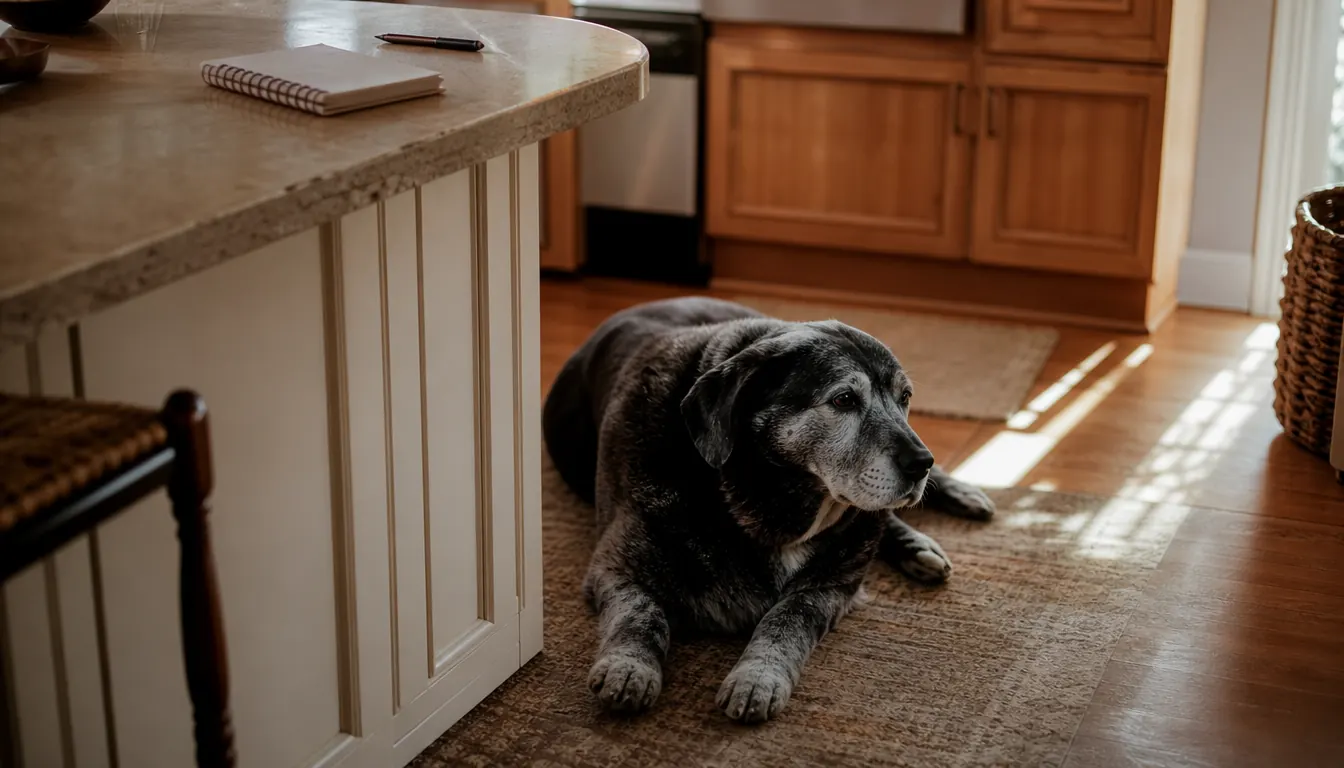
Otis started getting up off the living room floor the way a man gets out of a low chair after a long car ride. Not hurt. Just slow, and careful, and stiff through the hips until he had taken four or five steps and everything loosened up. The X-rays in October 2024 put a name on it: arthritis in both hips, worse on the right, plus a stiff left elbow. By then I had already done what most people do, which is stand in front of a wall of joint chews with no idea what I am looking at.
The turmeric I give him is a Coco and Luna tablet, bacon and liver flavored, and he has been on it since February 2026. This piece is only about that one bottle, and only about how I worked it into the bowl of a dog who was already on four other things. I am not a vet and I am not going to pretend a tablet cured him. I am 63, retired after 28 years dispatching school buses for one county district, and I live outside Findlay, Ohio with my husband Ron and one dog. The spiral notebook on the kitchen counter is the only reason I can tell you any of this with a straight face.
The bottle that sits in my pantry after Dr. Haldane read the label
Coco and Luna Turmeric is a bacon and liver flavored tablet with turmeric root and BioPerine, and it is what I have given Otis once a day with his dinner for about nine months. Have your own vet read the label before you start it, the same way I did.
Amazon Check Today's Price on Amazon →Step 1: Ask Your Vet Before You Open the Bottle
I did not order anything until I had carried the label in. Dr. Haldane has been Otis's vet since he was a puppy and she had already gone through every supplement container in my kitchen once. So I brought the printout for this one too, and she read the active ingredients line by line, turmeric root and BioPerine, and checked it against the four things he was already taking. That is not a formality. A dog on several supplements, at 11 years old, is not a dog you start something new on your own hunch.
What she told me was that it was fine to try. What she did not tell me was that it would fix him. That distinction mattered later, in February, when I was watching him come down the porch steps and hoping. Your dog is not Otis. Otis has arthritis in both hips and a stiff elbow, he is 74 pounds, and none of that is a reason to assume your dog will have the same experience with the same tablet.
So ask. Bring the bottle or the printout. Let someone who has seen your dog's X-rays say yes or no, and ask what to watch for in the first week, and ask whether anything he is already on would make this a bad idea. It is a five minute conversation that saves you a wasted bottle and, worse, a wasted month of thinking you are doing something when you are not.
Step 2: Pick One Meal and Put It There Every Day
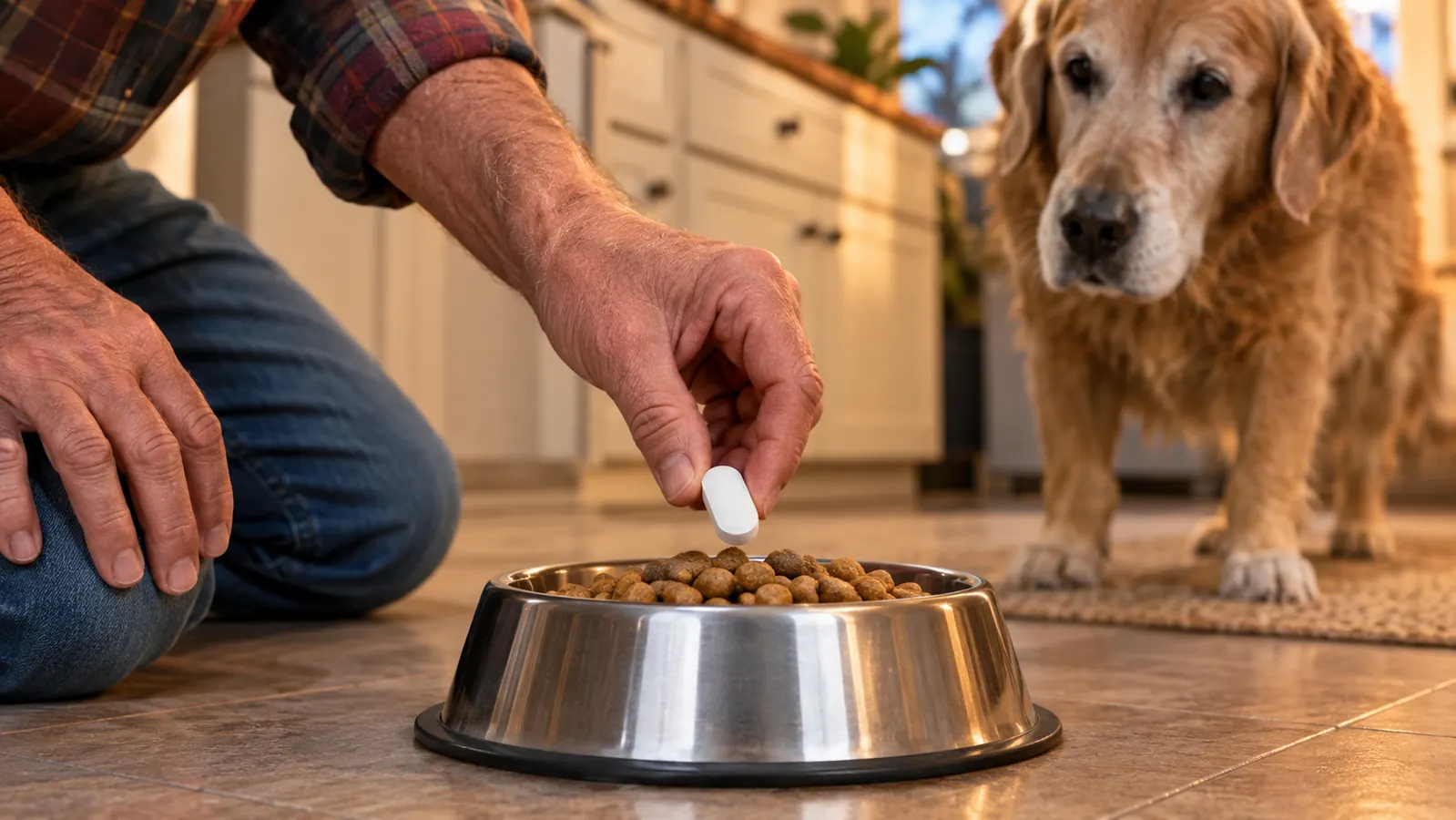
Otis eats at seven in the morning and five in the evening, plain dry kibble, no brand worth arguing about. The turmeric goes with dinner, and only dinner. Every other thing he takes goes on top of breakfast, and I made this one different on purpose so that if something went sideways with his stomach I would have a rough idea which meal to look at. The tablet goes on the kibble. He eats it plain. He has never once turned his nose up at it, which I cannot say for the fish oil.
The label's amount for his weight is what he gets, no more, and I do not add a second one on a cold morning because I feel bad for him. The bottle holds 120 tablets and weighs 115 grams and it lives in the pantry on the shelf with the flour, out of the light, and it is small enough that it does not get shoved to the back behind the big bags. Same bowl, same spot, same time of day. That is the whole ritual.
If your dog is a gulper who inhales a bowl in forty seconds, watch the first few days and make sure the tablet actually goes down instead of ending up in the bottom of the bowl. Otis is a Lab, so this was never a concern in our house. And if you free feed, this is the week to stop, because you cannot tell what a dog took if the bowl is always full.
One more thing about the routine: pick a meal you are actually home for. Dinner at five works here because we eat at five. If your evenings are chaos and your mornings are calm, put it on breakfast and move something else. The point is not which meal. The point is that the meal happens every day without you having to remember it, because a supplement given four days out of seven is a supplement you cannot judge.
Step 3: Change One Thing at a Time, Even When You Want to Hurry
I added things to Otis's bowl one at a time, months apart. Cosequin soft chews in November 2024 on Dr. Haldane's suggestion. Fish oil in February 2025. The green lipped mussel chews in May 2025. The hyaluronic acid liquid in September 2025. Turmeric in February 2026, because that was the winter the cold mornings were clearly his worst and I wanted to know whether we could take the edge off them. Five things across fifteen months sounds slow. It was slow. It was also the only way the notebook was ever going to show me anything.
If you put turmeric in the bowl on Monday and a new food on Tuesday and a new bed on Wednesday, you will have no idea what did what, and in six weeks you will be back in front of the same wall of joint chews, no smarter. I cannot prove which of the five helps Otis most. I have said that plainly before and I will say it here. What I can tell you is what happened in the weeks after the turmeric started, because nothing else changed in those weeks, and that is worth more to me than a faster answer.
The other reason to go slow is that it is reversible. One new thing means one thing to stop if it goes wrong. Five new things at once means you either stop everything and lose the ground you gained, or you keep going and hope. I have stood in the second position before and it is a bad place to stand.
Step 4: Give It Six Weeks and Write Down One Line a Day
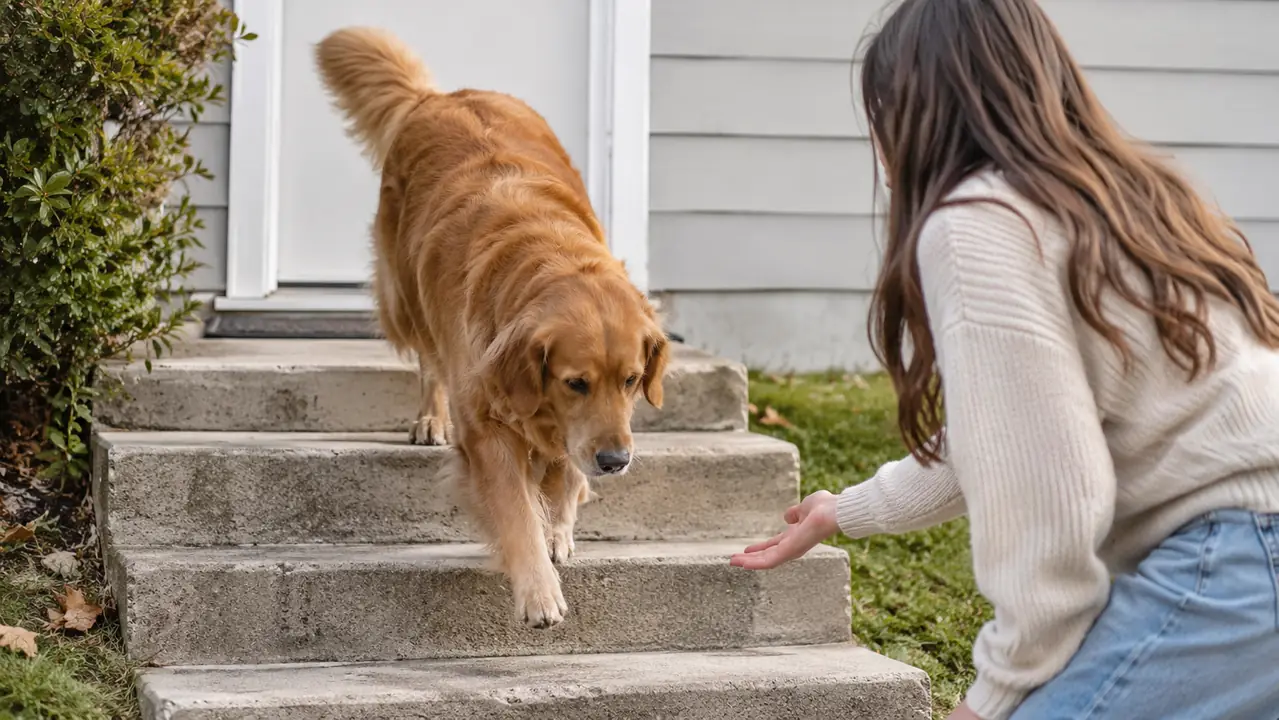
I do not trust my memory on this and neither should you. My notebook has one line a day and it takes ten seconds: how he got up in the morning, how he did on the three concrete steps off the back porch, how far we walked. There are no stairs in this house, so the porch steps are the whole test. Before the turmeric, the record for that winter reads the same most days. Slow to rise. Careful on the steps going down. Walk about twelve to fifteen minutes, shorter if it was wet.
The label mentions results showing in a couple of weeks. At two weeks I had nothing to write and I wrote nothing. At around six weeks I wrote that cold mornings seemed a little easier. That is the entire claim I am making and it is a modest one. I cannot tell you the tablet did it rather than the season turning, or the shorter walks, or the fact that he had been on the other four for months by then. I can tell you he had no stomach trouble on it, no loose stool, no going off his food, and those were the things I was watching for.
Read it back in blocks of a week, not day by day. Day by day you will see nothing, because a stiff dog has good mornings and bad mornings and the bad ones will scare you. Seven lines together tell you something. Ten weeks of seven lines tells you whether the thing you started is doing anything at all, or whether you are just watching a season change.
Decide in advance what would make you stop. For me it was vomiting, loose stool, going off his food, or any change in behavior that worried me. None of that happened, so he stayed on it. If it had happened I would have stopped, called Dr. Haldane, and put the date in the notebook, and that would have been the end of turmeric in this house. A supplement you cannot stop is not a supplement. It is a decision you are refusing to make.
Step 5: Keep Your Expectations the Size of the Change
Here is where I will lose anyone who wanted a different article. Otis is not young again. He does not run. He does not jump into the back seat of the Equinox and he never started again, and Ron still lifts his back end in when we go somewhere. He goes down the porch steps steadily now and he is still slow coming up them. He walks about twenty minutes, up from about twelve in October 2024, and that has been steady since summer 2025. Cold, wet days are still his worst days.
The turmeric is one line item in a list of things that got him from there to here. That list includes his weight staying at 74 pounds because Dr. Haldane asked us to keep him under 75. It includes the rubber backed runners in the hall that went down in 2024 after he slipped on the vinyl plank. It includes the walks getting shorter before they got longer, and Ron lifting him into the car, and me going down the porch steps ahead of him instead of behind. If you expect a tablet to do the work of all of that, you will be disappointed by week three and you will blame the wrong thing.
Coco and Luna is what I give him. It is not what stands between him and the floor. I would rather tell you that now, nine months in, than have you buy a bottle expecting a dog who trots, and quietly conclude that supplements are a racket when he does not.
What Else Helps
The floors matter more than people expect. Vinyl plank in the kitchen and the hall looked fine and was slick as glass under an old dog's back feet. The runners went down before any supplement did, and they changed how willing he was to walk through the kitchen to the back door. The three concrete steps off the porch are the other spot. I go down ahead of him and stay at the bottom rather than hovering behind him, because a dog who feels crowded on a step will rush a step, and a rushed step on a bad hip is how you end up at the vet on a Saturday.
Weight is the other lever and it is the least interesting one to talk about. Dr. Haldane asked us to keep Otis under 75 pounds and he has stayed at 74. Nothing I have bought for him has done as much for his hips as that number staying where it is. The rest of the bowl is his glucosamine soft chews, the fish oil that lives in the refrigerator door because Ron cannot stand the smell of it, the mussel chews, and the hyaluronic acid liquid. The turmeric went on top of all of it. It did not replace any of it.
Warmth is cheap and it helps more than you would guess. On the mornings when the temperature had dropped overnight, Otis was slower than on a mild morning with the same routine and the same bowl of food. He has a spot by the register in the kitchen and he found it himself. I am not going to tell you a warm floor is a treatment. I am telling you that a stiff dog on a cold morning is a stiffer dog, and it is worth knowing before you decide a supplement stopped working in January.
And then there is the vet. Otis gets looked at. If your dog is stiff and you have not had X-rays, the supplement aisle is the wrong first stop. Arthritis, hip dysplasia, an old injury, a soft tissue problem, all of those can look like a slow rise off the floor, and none of them are solved by guessing. The five steps above are what I did after a diagnosis. They are not a substitute for one.
The whole claim I am making fits on one line of a spiral notebook: cold mornings, seems a little easier. That is it. That is the review.
Nine months in, still in the pantry, still on the dinner bowl
Bacon and liver flavored tablets with turmeric root and BioPerine, 120 to a bottle, given once a day with dinner at the label's amount for Otis's weight. Have your own vet read the label first, then give it six quiet weeks and write down what actually changes.
Amazon Check Today's Price on Amazon →