

Otis turned eleven this past March. He is a black Lab mix, seventy-four pounds, and he has arthritis in both hips, worse on the right, plus a stiff left elbow that showed up on X-rays at Dr. Haldane's office in October 2024. He still walks every day, about twenty minutes now, down from thirty-five a few years back. What changed in the winter of 2026 was not the distance. It was the getting up. Cold mornings, the vinyl plank in the kitchen, and that long pause before he pushed off his front legs and found his feet. That pause is what sent me looking for one more thing to add, and that is how Coco and Luna Turmeric ended up on my pantry shelf in February.
Coco and Luna Turmeric is the fifth supplement Otis takes, and it is the only one I give at dinner. It is a bacon and liver flavored tablet, once a day, at the label's amount for his weight. I want to be straight with you about what nine months of notes can and cannot tell you. They can tell you he had no stomach trouble and that he still takes it without being coaxed. They cannot tell you it fixed anything, because by February 2026 he was already on four other things and I am not a veterinarian and neither is Ron. Dr. Haldane read this label before we opened the bottle. That is the order I would do it in again.
The Quick Verdict
Easy to give, easy on his stomach, and nine months of notebook lines suggest the cold mornings got a little easier. It did not make him young again and I would not tell you it did.
Amazon Check Today's Price →The One He Takes at Dinner Without Being Asked
Bacon and liver flavored tablet, once a day at the label's amount for his weight. Have your own vet read the label first, the way I did with Dr. Haldane.
Amazon Check Today's Price on Amazon →How I've Used It
The label gives an amount based on weight, and I used that number for seventy-four pounds, once a day. Not twice, and not split in half. I know people spread things across the day and I understand the reasoning, but the label said once and once is what he gets. It goes in at five o'clock with dinner. Breakfast at seven is the crowded meal at our house: the Cosequin soft chews, the fish oil poured over the kibble, the mussel chews, the hyaluronic acid. Putting the turmeric at the other end of the day kept the two meals separate and made it easier for me to remember which thing went where. The bottle stays in the pantry. Nothing about it needs the refrigerator.
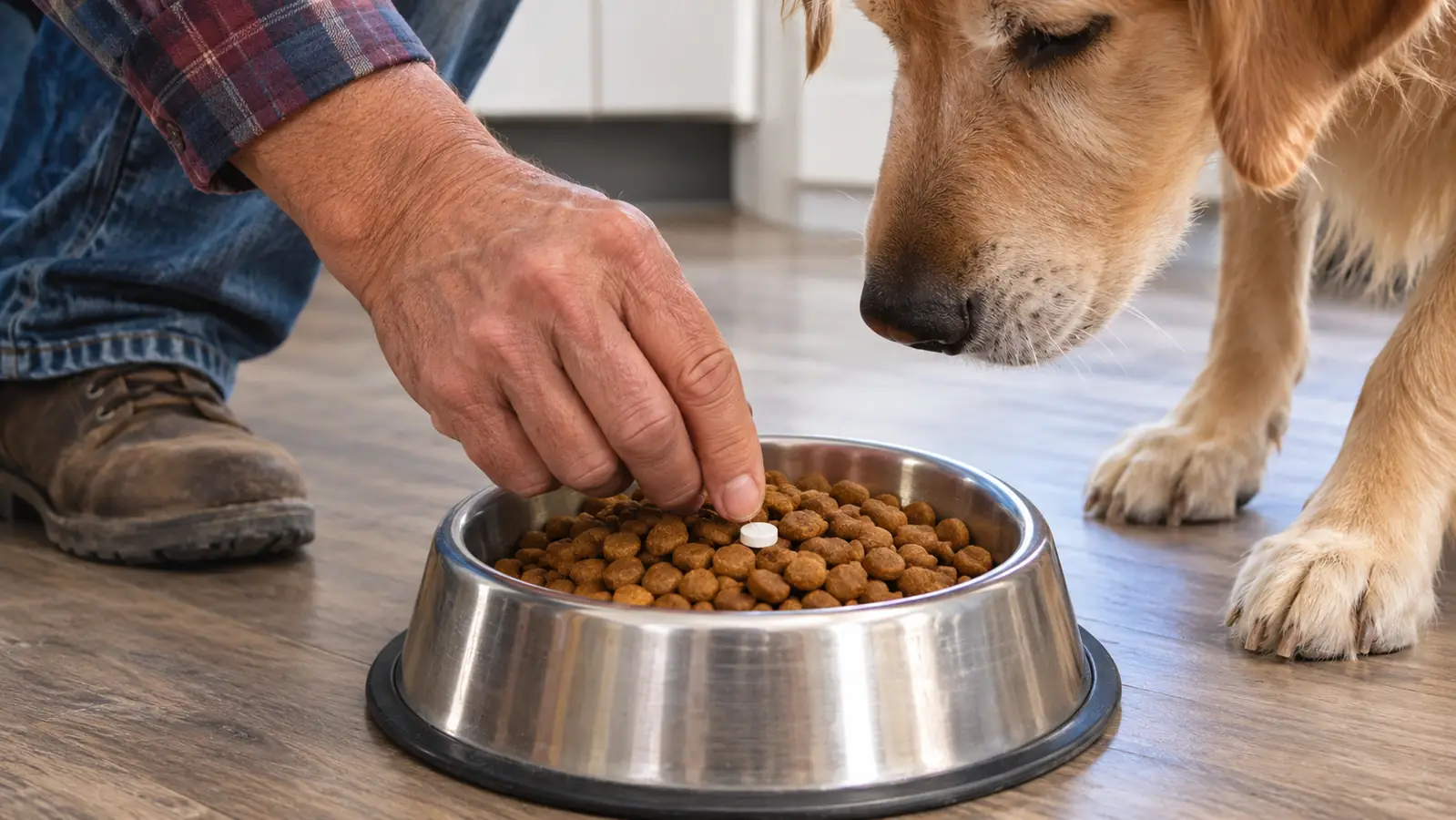
It is a tablet, bacon and liver flavored, and Otis takes it like a treat. I have never had to hide it in anything. That matters more than it sounds like it should when you live with an old dog who has grown suspicious of his own bowl after years of people putting things in it. The bottle is small, 4.53 by 2.2 by 2.2 inches, 115 grams, four point oh six ounces, 120 tablets. It fits on the pantry shelf between the canned goods and the box of dog biscuits.
The Coco and Luna tablet itself is small, maybe a little bigger than a piece of kibble, which is part of why it goes down without a fuss. The first evening I made a production of it. I set the tablet on the counter, read the weight chart on the back a third time to be sure seventy-four pounds landed where I thought it did, then put it on top of his dinner. He ate it and looked at me like I had forgotten something. Ron asked whether I planned to stand there all night. I wrote the line in the notebook at 5:12 and went and sat down.
The first week I stood at the back door every morning expecting something to happen overnight. Nothing did. I will say that plainly, because the label does not promise overnight and neither will I. Some of these things take weeks. Some of them do nothing at all. Either way, the notebook gets a line: how he got up, how he did on the three concrete steps out back, how far we walked. Turmeric has a reputation among dog people for upsetting a sensitive stomach, and Otis is what I would call sensitive in that he notices changes. Nine months in: no loose stools, no vomiting, no turning away from the bowl. That is one dog in one house. I am not going to tell you it cannot happen to yours.
What Is Actually in the Tablet
The active ingredients listed are turmeric root, written as Curcuma Longa L., and BioPerine. BioPerine is a black pepper extract, and it is in there because curcumin, the part of turmeric people are usually after, does not absorb well on its own. The listing describes curcumin as an antioxidant that supports joint and liver health, and says the formula is aimed at joint tenderness and mobility. The listed uses are antioxidant and anti-inflammatory support, hip and joint care, and skin care, for dogs of any breed size. That is what the label claims. It is not a promise, and it is not a dose any of us can check on our own.
The listing also says the tablets are veterinarian formulated and free of palm oil and corn, which are two things Dr. Haldane tends to look for when I hand her a label across the exam table. She did not hand this one back with a warning on it. She also did not tell me it would work. What she said, more or less, was that it was reasonable to try, that it would not interfere with anything else he takes, and that I should keep writing things down so we would both know.
I asked her three questions at that visit, and I remember them because I wrote them on the back of a receipt in the truck afterward. Whether turmeric could interfere with anything else he takes. Whether a dog with a sensitive stomach should start at half. Whether the BioPerine mattered. Her answers, in order: no, not at the amount on the label; start at the label's amount but stop and call if anything changes; and yes, probably, which is why the pepper extract is the second name on the list. I am repeating a conversation, not giving advice. Ask your own vet and get your own answers.
One thing I will not do is repeat the Amazon copy word for word. The listing leans on anti-inflammatory language, and I am not going to dress a label claim up as a result. I am not a veterinarian, I cannot see inside my dog's hips, and I will not pretend otherwise. What I can give you is the notebook. Nine months of one line a day, written in a kitchen outside Findlay by a retired school transportation dispatcher who has nothing better to do at six in the morning than watch her dog get up off the floor.
What Nine Months of Notes Showed
February through April, the lines read about the same as they had in January. Slow up in the morning. Fine once he was moving. Down the back steps steady, up the back steps slow. If you had asked me in April whether the turmeric was doing anything, I would have said I had no idea, and probably not. That is the honest answer and it is the one most people will not give you, because most people are selling something or they quit at week three and never find out.
Around the six week mark, which put us into the second half of March, I started noticing that the morning pause was shorter. Not gone. Shorter. He would still gather himself before he pushed up, but there was less rocking back and forth first. I wrote it down and I did not believe it, because I have been wrong about things before and because a cold snap ended and the mornings warmed up around the same time. Maybe it was the turmeric. Maybe it was the thermometer. I have no way to separate the two and I am not going to pretend I do.
For the record, the entry for Tuesday, March 24 reads: up slow but no rocking, porch down fine, porch up slow, walked 20, cold wind. The entry for the Tuesday before reads: up slow, rocked twice, porch down fine, walked 20. Two lines, nearly identical, and one of them is missing three words. That is what nine months of this looks like. Not a graph that turns a corner. A pile of nearly identical sentences where one small detail quietly stops showing up.
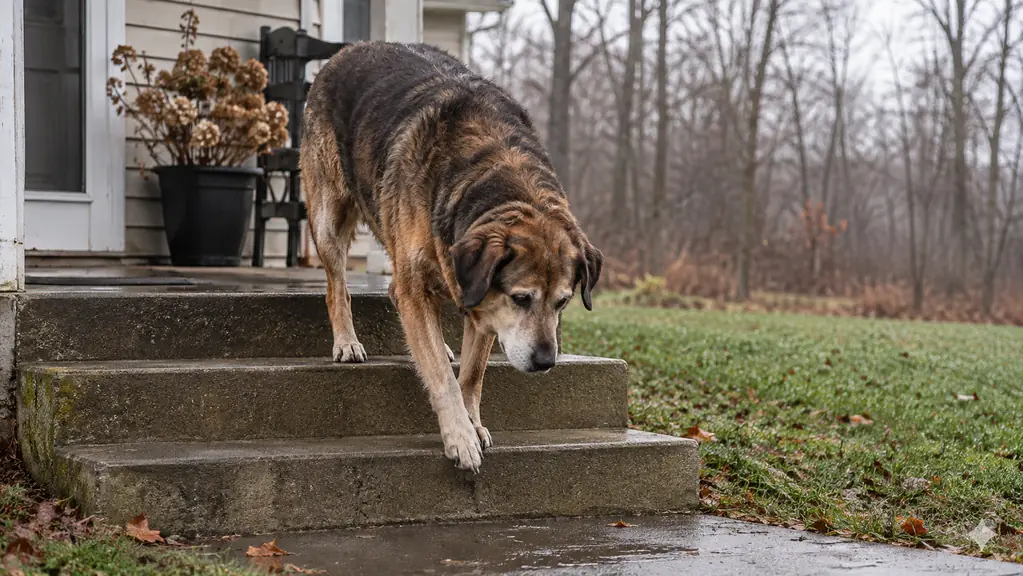
By summer the lines were consistent. Twenty minute walks, same route, same pace, and he was still asking to go. Down the porch steps steady. Up the porch steps still slow, and that never changed, not in nine months, not once. Cold, wet days are still his worst. The car is the same story. He does not jump into the Equinox and never started again; Ron lifts his back end in. No bottle changed that. He is not cured, he is not young again, and no supplement on my shelf made him run or jump.
What I Liked
- One tablet a day at dinner, and he takes it plain out of my hand
- No stomach trouble in nine months on a dog who notices every change
- Bacon and liver flavor means no hiding it in peanut butter
- Small bottle that lives on the pantry shelf, nothing to refrigerate
- Short, readable ingredient list: turmeric root and BioPerine
- Veterinarian formulated and free of palm oil and corn as listed
Where It Falls Short
- Six weeks before I noticed anything, and I am still not certain of it
- No effect I could see on the back porch steps going up
- Turmeric has a reputation for stomach upset, and one dog proves nothing
- Tablet form will not suit a dog who already refuses pills
- It went in alongside four other supplements, so I cannot credit it alone
- The label makes bigger claims than nine months of notes can support
The cold mornings got a little easier around week six. I wrote it down, and I still cannot tell you whether it was the turmeric or the weather.
How It Fits With the Other Four Things He Takes
Otis takes five things and they went in one at a time, months apart, so the notebook had a chance to show something before the next one arrived. The Cosequin soft chews came first, in November 2024, on Dr. Haldane's suggestion. The fish oil came in February 2025 for his coat. The mussel chews came in May 2025. The hyaluronic acid came in September 2025, and I nearly skipped that one because three already felt like plenty. The Coco and Luna turmeric came last, in February 2026, because that was the worst string of mornings we had had in two years.
That decision did not come from reading anything online. It came from the first week of February 2026, when we had four mornings in a row where Otis needed a second try to get his back legs under him. I called the clinic, Dr. Haldane was out until Thursday, and I spent the wait reading labels on my phone in the truck in the grocery store parking lot. That is the whole story of how this one got chosen. Not research. A bad week and a wait.
Because they overlap, I cannot tell you which one did what. I have said that before and I will keep saying it. What I can tell you is that the Cosequin was the first thing to show up in the notebook, back in January 2025, and that is the only time I will say one of these products worked first. Everything after that is layered on top of something that was already helping. If you are starting from nothing, you are starting from a different place than I was, and a fair comparison would need a year and a much better record keeper than me.
If you have read my notes on how turmeric and glucosamine chews stack up against each other, you already know I give him both, and this is the turmeric half of that pair. If you are still deciding whether turmeric is worth a conversation with your vet at all, start there. The order matters more than the brand.
Who This Is For
If your dog is stiff getting up and you have already covered the basics, meaning a joint supplement with glucosamine and chondroitin and a vet who has actually looked at X-rays, then a turmeric product is a reasonable next conversation. It is a small ask. One tablet, once a day, at dinner, and a dog who takes it like a treat instead of a wrestling match. It suits somebody willing to give it six to eight weeks and write down what they see, because the honest answer is that you will not know anything before then. If you keep a notebook, even a cheap one, you will know more than most people ever do about their own dog.
Who Should Skip It
Skip it if your dog is on prescription medication and your vet has not seen the label. Skip it if your dog refuses tablets and you have already lost that fight with three other supplements, because a tablet that goes uneaten is money in the trash. Skip it if you are hoping this replaces what your vet has prescribed, because it is not that and I would not treat it as that. And skip it if a dog who is only slightly stiff is already doing well on glucosamine alone. Adding a fifth thing to a dog who is fine is how you end up with a shelf full of half used bottles and a dog who never needed them.
Nine Months of Notes, One Bottle on the Pantry Shelf
One tablet at dinner at the label's amount for your dog's weight. Read the label with your own vet before you start, the way I did with Dr. Haldane.
Amazon Check Today's Price on Amazon →