
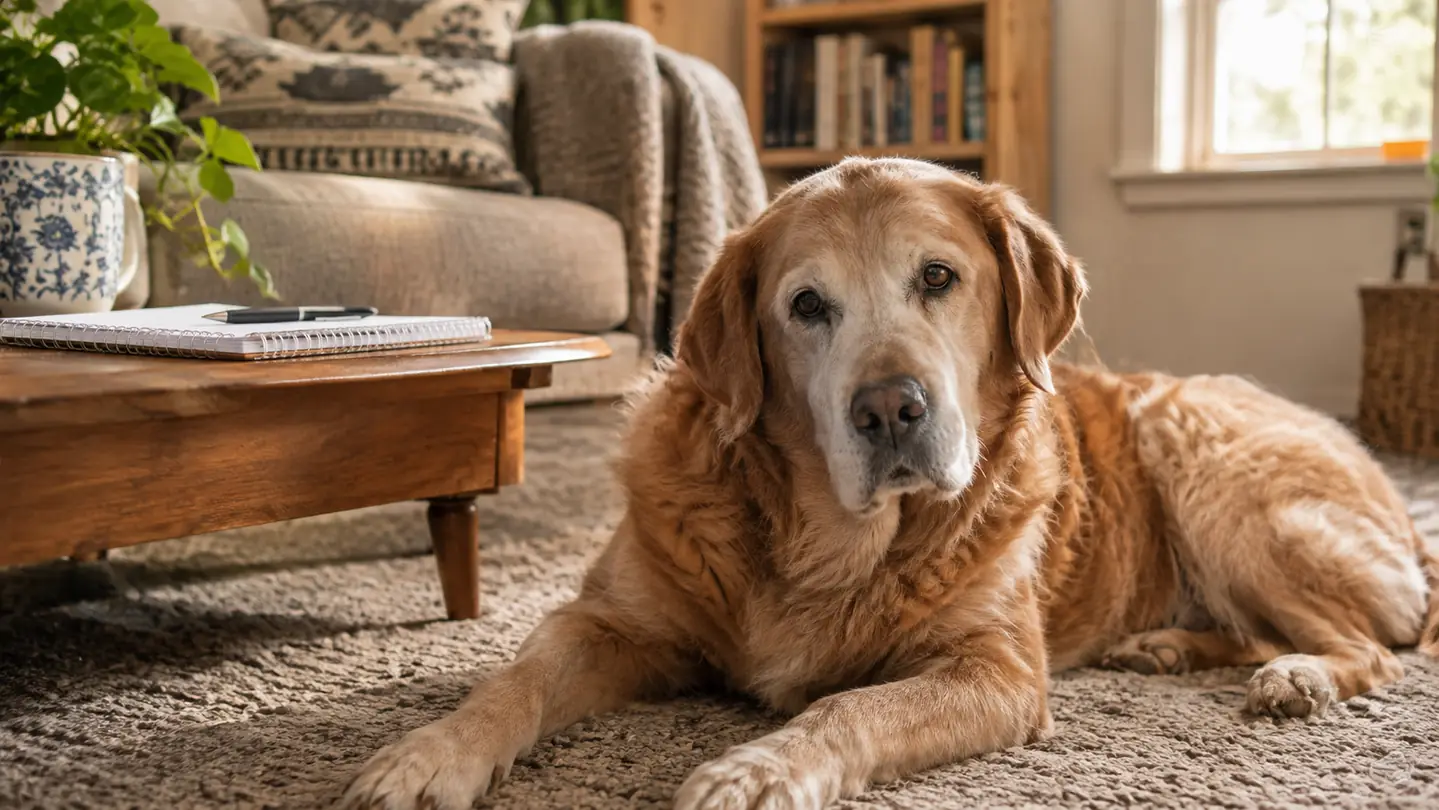
The first thing that changed was not a limp. It was a pause. Otis would be lying on the living room carpet, I would say his name, and there would be this half second where nothing happened at all.
Then he would gather himself and stand. I let that go on for most of a month before I mentioned it to Ron. I am the one in this house who writes things down. I did what most people do first: I stood in the feed store aisle reading labels for twenty minutes and came home with nothing, because I could not tell one promise from another. What I should have done sooner was call Dr. Haldane.
When I finally did, in October 2024, she took X-rays, showed me both hips, worse on the right, and a stiff left elbow, and said the thing that made the rest of this possible: pick one glucosamine product, give it at the label amount for his weight, and stay with it long enough to know. The one we picked was Cosequin soft chews. Otis has been on them about two years.
The one that got the first line in the notebook
Cosequin soft chews carry glucosamine, chondroitin and MSM, plus omega-3s, and go on top of breakfast at seven at the label amount for your dog's weight. Otis has not missed a morning since November 2024.
Amazon Check Today's Price on Amazon →Step 1: Get the Dog Looked At Before You Get the Chew
The order matters, and it is the part people skip. I am not a veterinarian. I am a retired school transportation dispatcher, twenty-eight years for one county district, and I have been around dogs my whole life without ever once being qualified to diagnose one. Otis had been slowing down for a while. I had a story in my head about it being the weather, or the floor, or just him getting older, and the story was wrong in one way and right in another. The X-rays told us what was actually going on. Arthritis in both hips, the right one worse, plus that stiff left elbow. He was ten then.
Dr. Haldane has been Otis's vet since he was a puppy, and she read the label on every single thing before he started it, which is a habit I would recommend to anybody. She also did not pretend a chew was going to fix a joint. She was plain that we were supporting him, not curing him, and she raised prescription pain medication as something we could revisit later. He is not on it. That matters, because it tells you where we are on the ladder. The glucosamine came low and early, and the strong stuff is still sitting there if we need it.
One practical thing about that visit. Bring the labels of everything your dog is already on, including the ones you assume are doing nothing, and ask specifically whether they stack. I brought three bottles to Dr. Haldane in the fall of 2024 and two of them turned out to be doing roughly the same job, which is how I ended up with one glucosamine product instead of a shelf of them. That conversation took about ten minutes and saved me a year of guessing.
Step 2: Dose It for Your Dog's Real Weight, Not Roughly
Cosequin's label gives an amount based on the dog's weight, and Otis sits at 74 pounds. I give him that amount, once a day, and I do not shave it and I do not top it up. Both temptations are real. You shave it because you want the bag to last. You top it up because it is a supplement and it feels harmless. Dr. Haldane's instruction was the plainer one: the label amount for the weight, no more and no less, and let the weeks do the work.
The other thing worth knowing is what is actually in it. The label lists glucosamine hydrochloride, sodium chondroitin sulfate and MSM, and there are omega-3s in the chew as well, which is why the same product gets talked about for skin and coat. I am not going to pretend I understand the chemistry. I understand that Dr. Haldane looked at that list and said yes, and that two years later he is still on the same thing, which is its own kind of answer.
If your dog is already on a joint product from the vet, do not stack a second glucosamine on top of it without asking first. I asked, and the answer in our case was to consolidate rather than add. Two products doing the same job is not twice the help. It is less money going out the door.
The 120-count bag lasts us about two months at his amount, so I replace it before it runs out rather than on the morning it does. Running out is how a dog ends up off it for four days and you end up wondering why he is stiff again. That is not the chew failing. That is a Tuesday.
Step 3: Set It on Breakfast and Stop Moving It Around
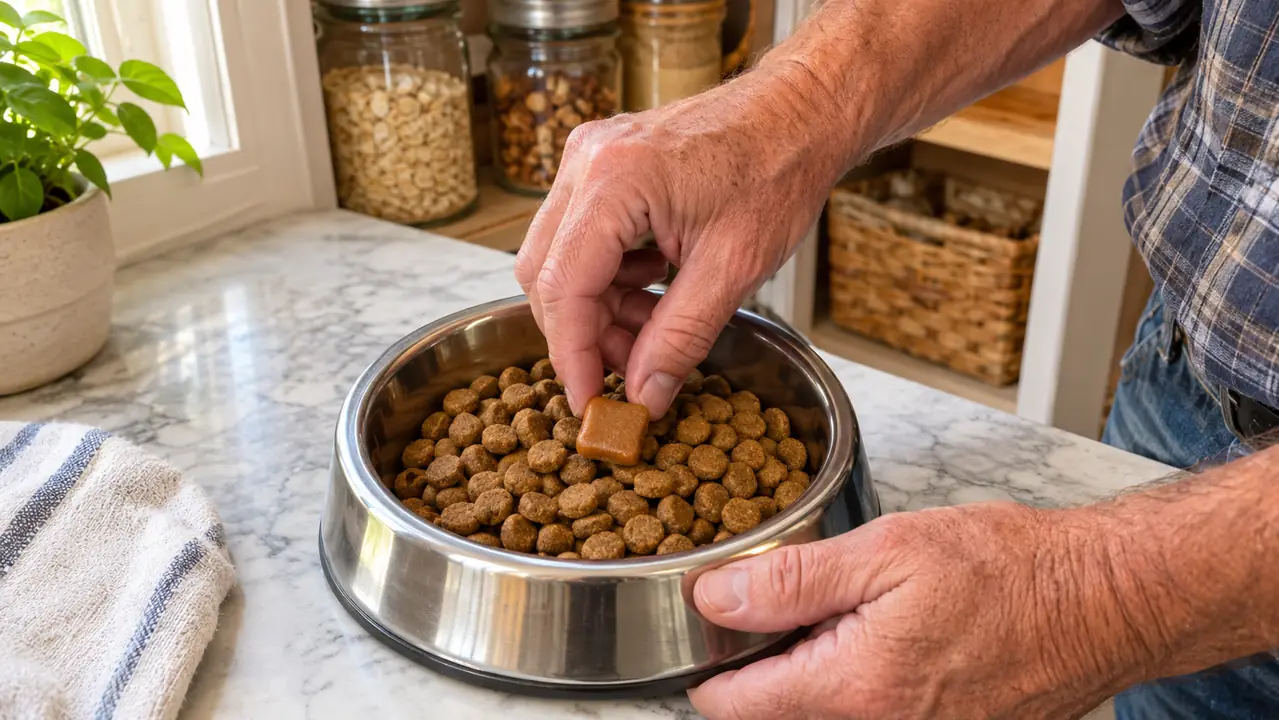
Otis eats at seven and again at five. The chew goes on top of his kibble at seven, and he takes it first, before he has properly started on the bowl. That is the whole method. It is not sophisticated. It works because it is the same time, the same bowl and the same hand every morning, and neither Ron nor I have to remember anything by nine o'clock.
Keep the bag where you actually stand. Ours lives in the pantry, on the shelf at eye level, next to the bowl. Not in a cupboard above the fridge and not out in the garage. If getting it out is a project, there will be mornings it does not happen, and the label does not say anything about skipping Tuesdays.
One more thing. If your dog starts turning his nose up at a chew he used to take, that is information, and I would want to know why before I pushed it. Ours is a soft chew, which I think helps, because he is not working at it the way he would at a hard biscuit. He has never refused one, and I would notice if he did.
Step 4: Keep One Line a Day or You Will Never Know
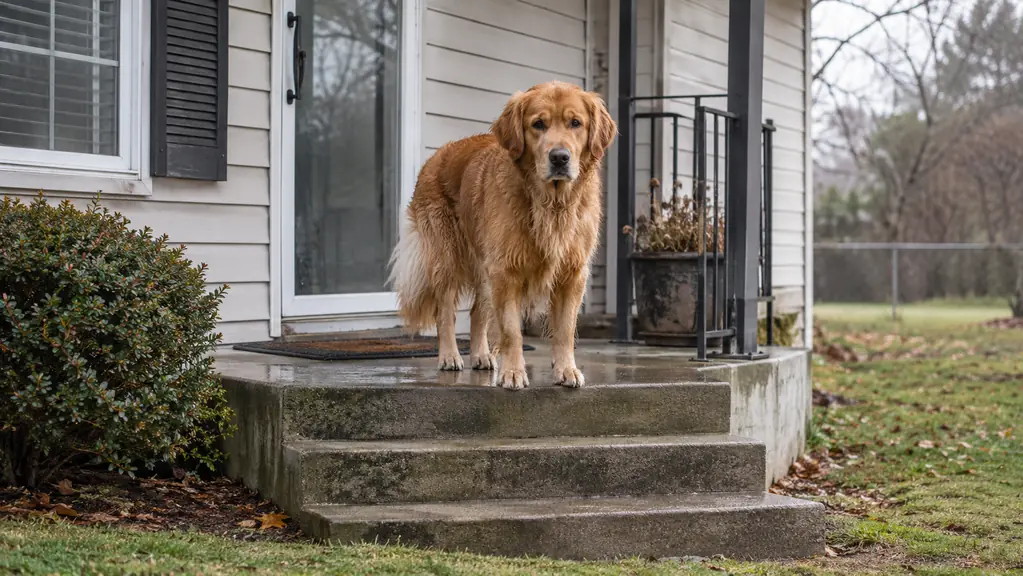
There is a spiral notebook on my kitchen counter and it has been there since the fall of 2024. One line a day. Three things in that line: how he got up, how he did on the three concrete steps off the back porch, and how far we walked. That is it. No scores, no ratings out of ten. I am not running a trial. I am trying to remember what last month looked like, because I promise you cannot.
The baseline is the part people leave out, and it is the part that makes the rest useful. In October 2024 his walks were down to about twelve minutes from the thirty-five we used to do. Getting up off the carpet took a beat. Coming in from the yard he took the three porch steps one at a time. Without that written down, the improvement later would have been a feeling rather than something I could point at.
The first change showed up at six to eight weeks, by January 2025, and it was not the walking. It was the getting up. He came off the floor in the morning with less of that pause. That was the whole entry. I did not write that he was better, because he was not better, he was slightly less stiff getting vertical. Two years on I would still describe it that way.
I read the notebook back every few months, usually on a Sunday with coffee, and what strikes me is how little a single day tells you. One good morning proves nothing and one bad morning proves nothing either. It is the shape of a month that says something, and you only get the shape if you wrote the boring days down too.
Step 5: Give It Eight Weeks and Add Only One Thing at a Time
Eight weeks is the number I would give anyone. If I had judged Cosequin at two weeks I would have quit it, because nothing happens in two weeks. The label world is full of products that claim you will see something inside a fortnight. My notebook says otherwise for this dog. The honest timeline was somewhere in the second month.
That is also why I added things one at a time, months apart. Nordic Naturals fish oil came in February 2025 and did nothing I could point to in the joints at all, though after about eight weeks his coat was less flaky. Zesty Paws mussel chews came in May 2025, and at about six weeks he stopped dragging on the last stretch of the walk, modestly. LubriSyn HA came in September 2025, and I nearly skipped it because he was already on three things. At two weeks nothing, at about five weeks steadier going down the porch steps, modest. The turmeric came in February 2026 because winter mornings are his worst, given on dinner rather than breakfast, and I think cold mornings got a little easier after about six weeks and I cannot say for sure.
Here is the part I would want a stranger to tell me. Because those five overlap, and because I never stopped one to test it, I cannot prove which one did what. Some of it is probably the glucosamine. Some of it might be the mussel or the hyaluronic acid. Some of it is the twenty-minute walk and the ten pounds he does not carry. I would rather say that plainly than tell you a story about one bag that turned my dog around.
The entry that changed in January 2025 was not about the walk. It was about a dog getting up off the floor in the morning without the pause.
What Else Helps
Weight is the biggest one and it costs nothing. Dr. Haldane asked us to keep him under 75 pounds, and at 74 he has stayed there. Every extra pound on arthritic hips is a pound he carries up those porch steps four times a day.
Floors matter more than people think. Our kitchen and hall are vinyl plank, and in 2024 he slipped on it, so there are rubber-backed runners down the hall now and they have stayed. The living room is carpet and he chooses it on his own. The house is a one-story ranch, which is luck rather than planning. There are no indoor stairs to manage.
Walking, but not too much of it. Twenty minutes, most days, and that has held steady since the summer of 2025. On a cold wet morning he still does not want to go, and I do not make him. Damp days are his worst and no chew has changed that.
Get the vet to put hands on him again every six months or so. Dr. Haldane checks his hips and that elbow at his regular visits, and it was at one of those that she reminded me a chew is not a substitute for the conversation about pain medication. I like having that on the calendar rather than waiting until something goes wrong.
And the car. I want to be straight with you, because this is where I see products oversold. Otis does not jump into the Chevy Equinox. He stopped, and he never started again. Ron lifts his back end in. Nothing in a bag changed that, and if a label tells you it will, that label is lying to you. What the Cosequin and the others did was make the getting up, the getting down the steps and the last ten minutes of a walk a bit easier. He is not cured. He is not young again. He does not run. He is eleven, he has arthritis in both hips, and he is doing better than he was in October 2024. That is the whole claim.
Two years in, still going on top of breakfast at seven
If your dog has started pausing before he stands up, this is where I would start, and I would start it after a vet has seen the X-rays. Ours has not missed a morning since November 2024.
Amazon Check Today's Price on Amazon →