
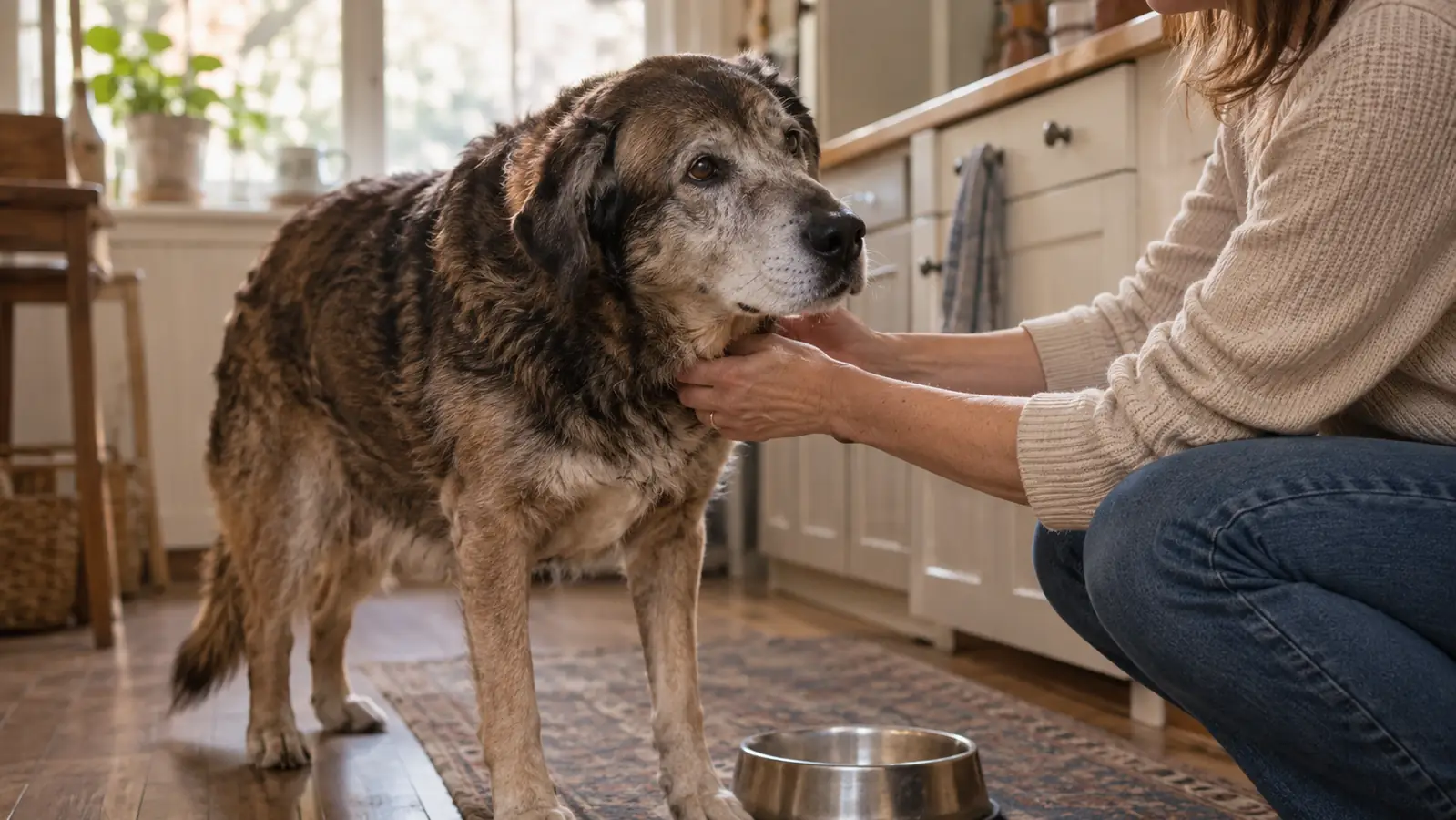
The bottle is the easy part. It is the getting it into the dog, day after day, without spilling half of it on the counter or turning breakfast into a wrestling match, that people ask me about. I have been doing this since September 2025 with Otis, our black Lab mix. He is eleven now, seventy-four pounds, and he has arthritis in both hips, worse on the right, plus a stiff left elbow that showed up on X-rays in October 2024.
I am not a vet and I am not a vet tech. I dispatched school buses for twenty-eight years and I retired three years ago. What I am is a person who keeps a spiral notebook on the kitchen counter and writes one line a day about how my dog got up, how he did on the three concrete steps off the back porch, and how far we walked. That notebook is the reason I can tell you anything useful at all. So here is the whole routine, start to finish, including the parts I got wrong at first.
The bottle I pour over Otis's breakfast every morning
LubriSyn HA is a clear liquid, poured once a day over food, dosed by your dog's weight. It is the fourth thing I added to Otis's bowl, not the first, and I will tell you honestly what it did and did not do.
Amazon Check Today's Price on Amazon →One thing before any of this. Every dog is different, and senior dogs are carrying more than one thing at a time. Otis's vet, Dr. Haldane, has seen him since he was a puppy, and she read every label before anything went into his bowl. Yours should read yours. Call your own vet and ask. That is not a formality I am tacking on at the end; it is Step 1, and I mean it.
Step 1: Get the label and the weight chart in front of your vet first
I brought the bottle into the exam room. Not a photo of it, the bottle. Dr. Haldane turned it around, read the ingredient line, and asked me what else Otis was on. At that point he was already taking Cosequin soft chews, Nordic Naturals fish oil, and Zesty Paws mussel chews. I told her I was worried about piling a fourth thing on top of three.
She said it was fine to try. She also said the thing I have repeated to every person who has asked me about this since: with four supplements going at once, you will never be able to prove which one did what. I already knew that. I had decided I could live with it, because I was not running a study, I was trying to get my dog down the porch steps without that hitch.
What your vet will want to know is weight, other medications, and whether your dog has any history that makes a new supplement a bad idea. Have those answers ready and the conversation takes five minutes. Do not guess at the weight. Otis gets weighed at every visit and Dr. Haldane's standing note in his file is to keep him under seventy-five pounds. He has stayed at seventy-four, and that number is what the dose is built on.
Step 2: Measure by weight, once a day, the same time every day
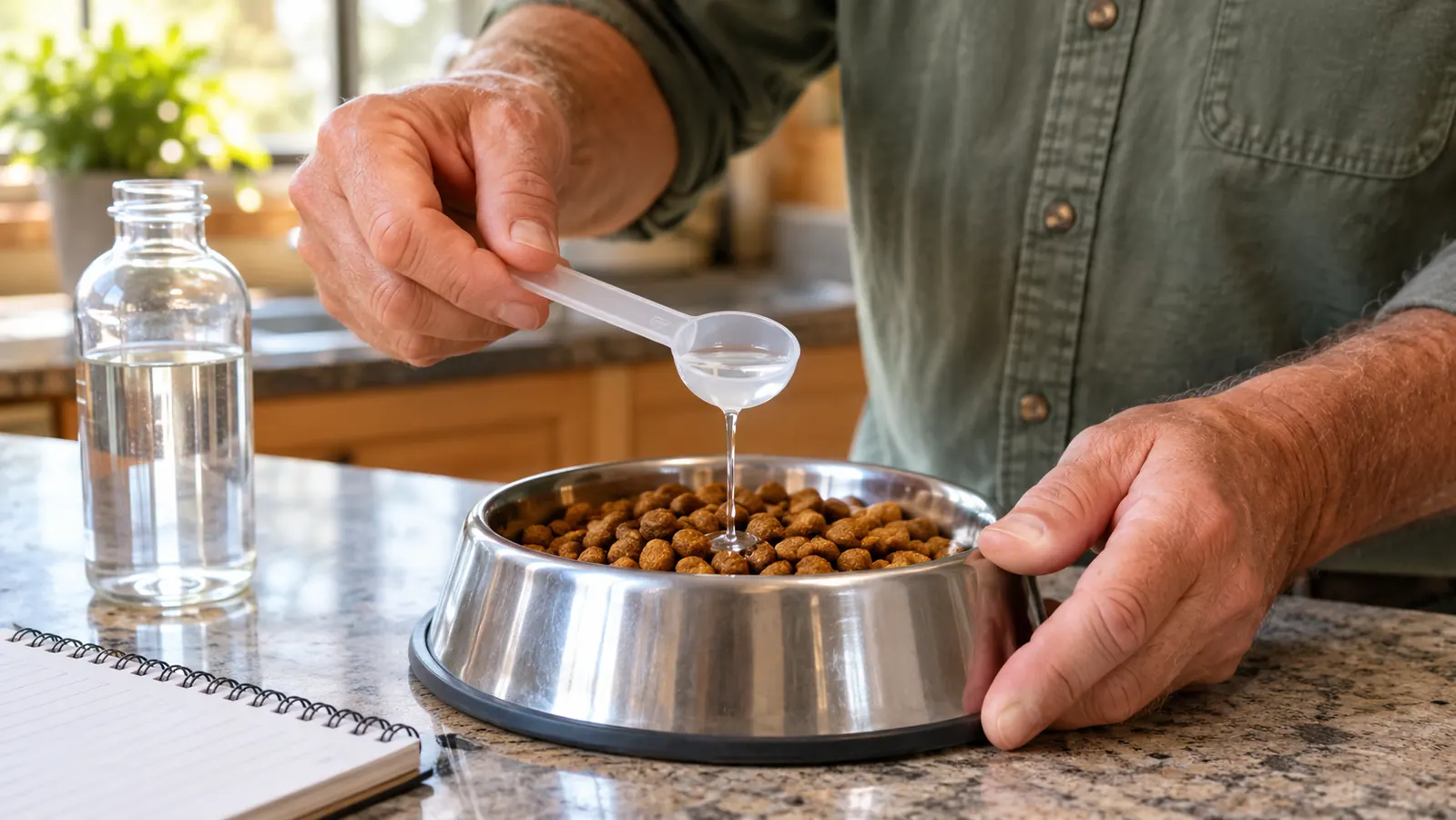
The label gives you an amount based on your dog's weight. For Otis at seventy-four pounds, that is what I pour. I do not eyeball it. I do not round up because he is a big dog and I want it to work faster. I use the measure and I level it, and the reason is simple: if I change the amount, the notebook stops meaning anything. I would not know whether a good week was the supplement or the extra half spoon I gave him.
Once a day, over breakfast. Breakfast is at seven, dinner is at five, and this goes on the morning bowl. Why morning? Because that is when I am standing in the kitchen with the bottle already out and the kibble already in the bowl, and a routine I can do half asleep is a routine that survives a bad week. The other four things he takes are all at breakfast too, with one exception I will get to.
If your dog eats twice a day and you are more reliable in the evening, put it on the evening meal. The point is not the hour. The point is that it happens every day and that you do it the same way, so that when something changes you know what changed.
Step 3: Pour it over the food, then watch the bowl
LubriSyn HA is a clear liquid, slightly sweet according to the label, and it goes straight over the kibble. No hiding it in peanut butter, no pilling, no holding his mouth shut. That is the whole reason I was willing to try a liquid in the first place. Otis is a Lab, which means he has never in his life needed persuading to eat, but I have had dogs over the years that would pick a pill out of a piece of cheese and set it on the floor beside the bowl, and I did not want that fight at seven in the morning.
He does not notice it. That is the honest answer. It disappears into the kibble and he eats the same speed he always has. If your dog is a slower or pickier eater, pour it over a smaller portion at the top of the bowl rather than the whole meal, so it does not sink to the bottom and get left behind with the last few kibbles.
Storage: the bottle lives in the pantry, in the same spot, and I do not move it around. The fish oil is the one that goes in the refrigerator door after opening, and that is a different bottle entirely, so do not get the two habits confused. Read your own label for storage and follow it, not mine.
The label says results may show in seven to fourteen days. At two weeks I had nothing in the notebook. I almost quit. At five weeks he was going down the porch steps without that pause at the top.
Step 4: Give it five weeks before you decide, and write it down
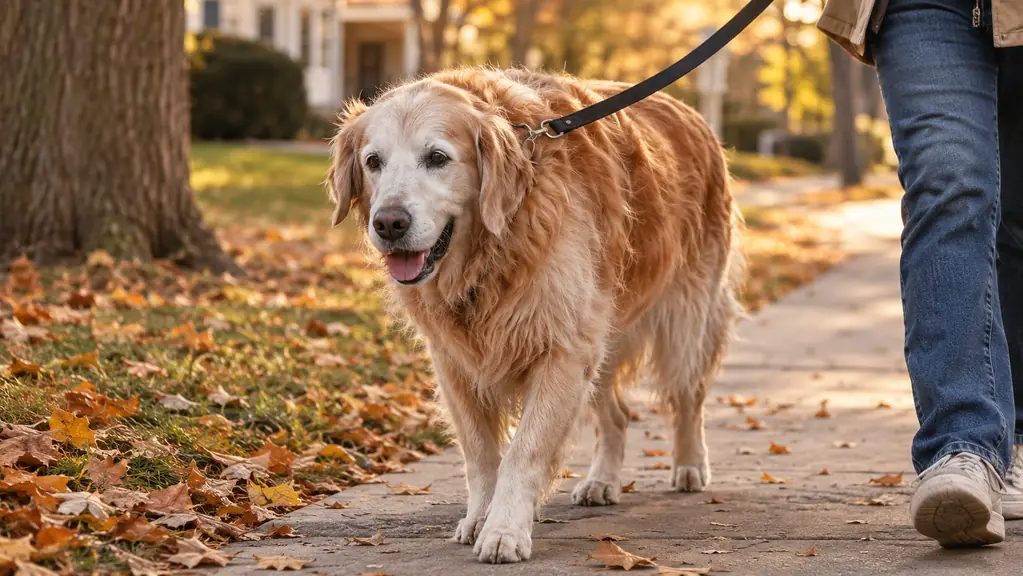
This is the step people skip and it is the one that matters. The label on this bottle says results are typically visible in seven to fourteen days. I watched at two weeks and saw nothing I could point to. Otis was still hesitating at the top of the porch steps and still slow getting up off the carpet in the morning. If I had been judging by how I felt about it on day fourteen, I would have stopped.
At about five weeks, the notebook had something. He was steadier going down the porch steps. Not faster, not bouncy, steady. The hitch where he would stand at the top and think about it got shorter. That is the entire claim I am making and I am making it about one dog. It was modest and it took longer than the label suggested.
The notebook is one line a day. Mine looks like this: "Tues 11/4. Up easy. Steps down fine, up slow. Walked 20." That is it. Three things, every day, and it takes fifteen seconds. Without it I would be telling you how I feel about my dog's progress, and how I feel is not reliable. I want him to be better, so I see better. The notebook does not want anything.
Pick your three things before you start. Getting up in the morning, one specific set of steps, and how far you walked are mine. Do not pick something vague like "seems happier." You cannot compare vague across five weeks.
One clear liquid, poured over breakfast, measured by weight
If your dog already takes three things and you are wondering whether a fourth is worth the trouble, this is the one I added with the least fuss and the longest wait.
Amazon See the 8 oz bottle on Amazon →Step 5: Don't change two things at once, and don't stop everything to test one
I added things months apart on purpose. Cosequin in November 2024. Fish oil in February 2025. Mussel chews in May 2025. LubriSyn HA in September 2025. Turmeric in February 2026 because winter mornings were his worst. The gaps gave the notebook a chance to show something before the next thing went in.
What I will not do is stop all five for two months to see what happens. There are people who would tell you that is the rigorous way to do it. They are probably right, and it is not happening. My dog is eleven and this is not a lab experiment. So I say the honest thing instead: because these overlap, I cannot prove which one did what. All I can tell you is what the notebook shows, in order.
If you are starting from nothing, the simplest version is one new thing, then wait six to eight weeks, then decide. The first thing I tried, on Dr. Haldane's suggestion, was Cosequin, and by January 2025, six to eight weeks in, the notebook showed he was getting up off the floor in the morning with less hesitation. That was the only time I have been able to point to a single product and say that.
What Else Helps
The supplement is not the whole story, and I would be lying if I let you think it was. Three other things changed in this house and I would put any of them up against a bottle.
Weight. Dr. Haldane asked us to keep Otis under seventy-five pounds and he has stayed at seventy-four on plain dry kibble, breakfast at seven and dinner at five, no brand worth naming. Every extra pound on a dog with arthritic hips is a pound those hips carry. If your dog is carrying five pounds too many, that conversation with your vet is worth more than anything you can buy.
Floors. In 2024 Otis slipped on the vinyl plank in the kitchen and hall. We put down rubber-backed runners and have not had a slip since. It cost less than the supplements and I noticed the difference in a week. It was not a cure for anything, it was just a dog who stopped scrambling.
The car. I have to be straight with you about this one. Otis does not jump into the Equinox. He stopped and he never started again, and Ron lifts his back end in. Not one of the five things in his bowl changed that. You will read a lot of reviews that promise a dog jumping into the truck again. That has not been our experience and I do not expect it to be.
The porch steps are the one piece of terrain we do not fix. There are three concrete steps off the back and he goes down them every day to the yard. Steady down, still slow up. Cold, wet mornings are still his worst. He is not cured, he is not young again, and no bottle on my counter made him run.
The Short Version
Read your label, call your vet, weigh your dog. Measure by weight, once a day, over the morning meal, same way every time. Give it five weeks before you form an opinion, and write three things down every day so your opinion has something behind it. Do not add two new things in the same month. And if your dog is carrying extra weight or slipping on your floors, deal with those first, because they are cheaper and they work.
LubriSyn HA is the fourth thing I added and it is still in the pantry fourteen months later, poured over breakfast. Modest result, longer wait than the label implies, no stomach trouble, and no drama at the bowl. That is the whole review. If you want the longer version, I wrote up the full fourteen months separately, and I put it side by side with a liquid HA product I have never given Otis, judged on labels alone.
Fourteen months in, still in the pantry, still poured at seven
8 ounces, clear liquid, dosed by weight, poured once a day over food. Ask your vet first, then give it five weeks and a notebook before you decide.
Amazon Check Today's Price on Amazon →