

The hardest part of adding fish oil to an old dog's food is not the pouring. It is everything that happens before you pour. Which container to buy. How much actually goes in the bowl. Whether it will loosen his stools and cost you a week of worrying. And how you will ever know, three months down the road, whether it did anything at all or whether you are just hoping out loud.
I am Peggy Dunning. My husband Ron and I live outside Findlay, Ohio, with Otis, a black Lab mix who is eleven this year and weighs 74 pounds. He has arthritis in both hips, worse on the right, plus a stiff left elbow that showed up on X-rays at his October 2024 vet visit. Dr. Haldane has been his vet since he was a puppy, and she reads every label before anything goes into his bowl. That is how Nordic Naturals Omega-3 Pet ended up in our kitchen in February 2025. It has sat in the refrigerator door for about twenty-one months now, poured over the same breakfast, and that is long enough that I have made most of the small mistakes a person can make with a liquid supplement.
What follows is the order I would do it in if I were starting over tomorrow. None of it is complicated. Most of it is about slowing down, because the pouring itself takes four seconds and the decisions around it are what determine whether you learn anything.
The fish oil that has been in my refrigerator door since February 2025
Liquid, unflavored, and measured straight over kibble. This is the one Dr. Haldane read the label on and approved for Otis, and the one I am still pouring twenty-one months later. Check the weight chart printed on the container before you start.
Amazon Check Today's Price on Amazon →Step 1: Have your vet read the label before you buy anything
I am not a veterinarian and I am not going to sound like one. Before Otis had a single drop, I carried the container to a regular visit and asked Dr. Haldane to look at it. She turned it over, read the back, and asked two questions: what else is he on, and how is his stomach. Those two answers decided the rest of it.
She looked for the EPA and DHA amounts and the size of the container, so she could match the weight chart to a dog of 74 pounds. She read the back panel out loud, which is her habit, and she turned the container over twice hunting for the chart, because it is printed small on the side and easy to walk right past. She noted that the oil is in the triglyceride form, which the label states plainly, and she noted the allergen line, because the container says fish and she wanted that in his record. Then she compared it against the Cosequin soft chews he had started in November 2024, which carry some omega-3s of their own. The overlap was fine with her. She wanted to know about it, which is a different thing from minding it. I wrote her answer on a sticky note and stuck it inside the cabinet door, and it stayed there until the adhesive gave out in the summer heat the following July.
The question I would ask first, if I were you, is whether your dog is on any prescription pain medication. Otis is not. We talked about that as something to revisit later, and I would rather have that conversation before starting a supplement than after. Your own vet knows your dog's kidney numbers and his history. A product page does not.
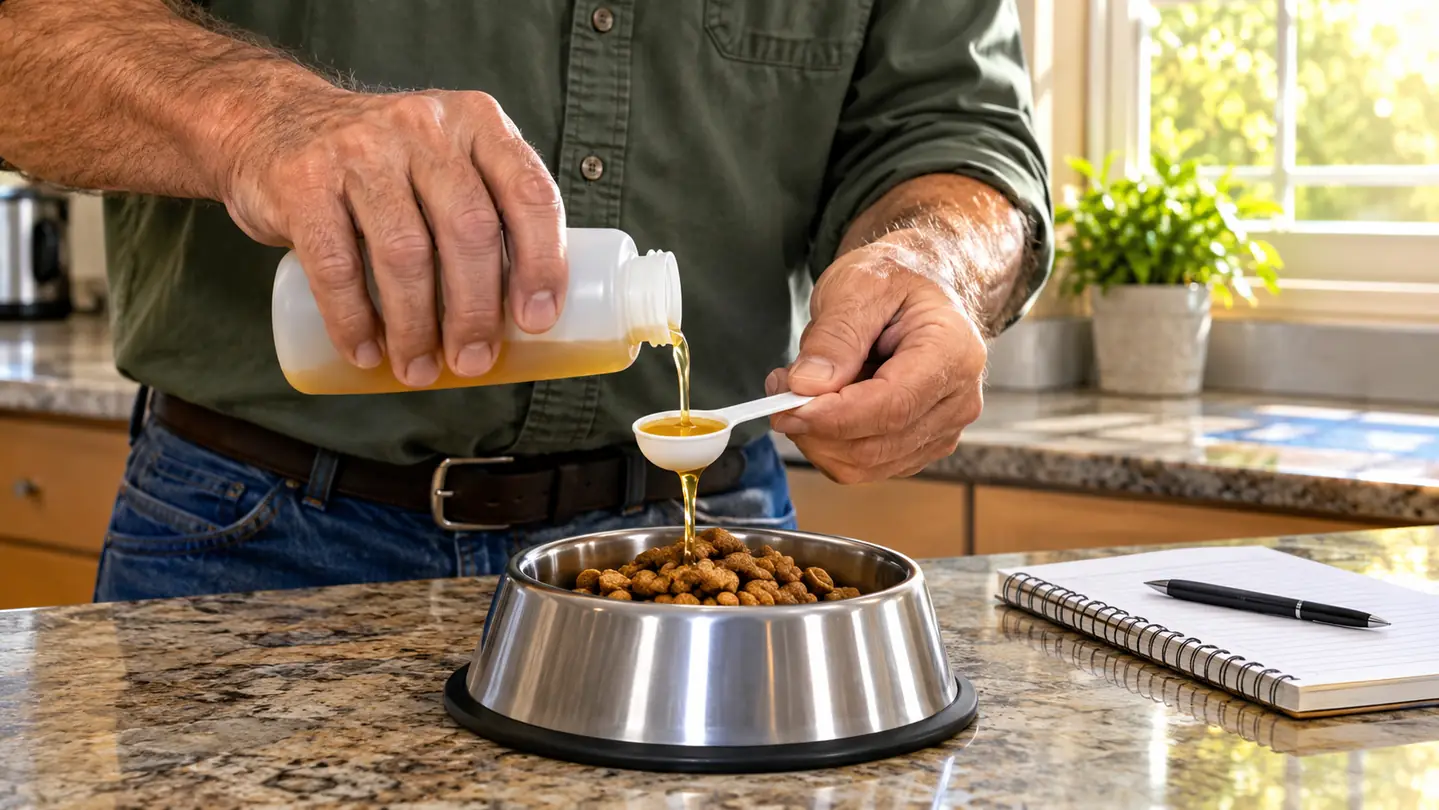
Step 2: Take the amount from the weight chart and write it down
The number comes off the weight chart printed on the container, not off a forum and not off me. For Otis at 74 pounds it gave a set amount, and I measured it with an ordinary measuring spoon out of the kitchen drawer. That spoon now lives in the same drawer and does nothing else. My first mistake was using a teaspoon out of the cutlery drawer, which is a different size from a measuring spoon and holds a good deal more when you are rushing at seven in the morning. I caught it on the third day, poured that morning's bowl anyway because I was not going to throw it out, and drove to the store for a proper set that afternoon. The set cost less than lunch and it ended the guesswork entirely. It sounds fussy until you have tried to eyeball a liquid over kibble with a dog staring at you.
I wrote the amount on the first page of the notebook I keep on the counter, in ink. I have not changed it since, because his weight has not changed. The temptation in month two is to decide that a little more would work faster. I felt that. I did not do it, mostly because Dr. Haldane had given me a number and I did not want to explain to her why I had invented a different one.
If you are moving from a capsule or a soft chew to a liquid, do not carry the old number across. Read the chart on the container you actually have in your hand, because the concentrations are not the same and the chart is the only thing that knows.
Step 3: Pour it over the food he already eats, at the same time every day
Otis eats plain dry kibble, breakfast at seven and dinner at five, and the fish oil goes over breakfast. It is unflavored, so the bowl smells like the bowl. He has never once turned his nose up at it. Ron has complained about the smell far more than the dog ever has, and Ron does not have to eat it.
Breakfast instead of dinner was my choice, not an instruction. It gives the day a chance to show me something, and if his stomach were ever going to object, I would rather that happen at nine in the morning than at ten at night. Our routine never varies. Ron lets him out to the back porch while I fill the bowl, Otis comes back in and stands in the same spot by the counter, and I pour the oil over the kibble before it goes down on the floor. He does not start eating until the bowl is on the tile, which means I have never once had to fish anything back out of his mouth. The oil also stays clear of his turmeric tablet, which goes with dinner and is the only one of his five things that is not at breakfast. Splitting them means a bad night points at one suspect instead of five.
One change at a time is the whole trick. I added his supplements months apart on purpose. If you put fish oil, a new chew, and a new food into the bowl in the same week and something goes sideways, you cannot tell which one to pull out.

Step 4: Keep it cold and watch the date
The Nordic Naturals container lives in the refrigerator door and has since the day it was opened. Never on the counter, not even for the ten minutes it takes to fix breakfast. It is an eight ounce container holding 237 milliliters, so it does not get lost behind the milk, and that is most of why the door works for us. It stands on the lower shelf where I can reach it without moving anything, which matters more than it sounds when you are doing this every single morning for two years.
I check the date on it whenever I open a new one, and I smell it before the first pour. Fish oil that has turned smells worse than fish oil, and that is the only test I have. It has not happened here, because a container does not last long in this house. If yours lasts months, smell it before every single pour and trust your nose over the calendar.
Ron moved it to the counter once, early on, to make room for something. I moved it back. The one time I left it out overnight by accident, in July 2025, I had set it down beside the coffee maker while I answered the phone and it sat there until Ron found it at bedtime. I poured the next morning's dose anyway, then worried about it until dinner and watched him every time he went out. Nothing came of it. I still would not make a habit of it. Keep it cold and the worrying stops.
Step 5: Give it eight weeks and write one line a day
The notebook on my counter gets one line a day: how he got up off the living room carpet in the morning, how he did on the three concrete steps off the back porch, and how far we walked. That is the whole system. It takes less time than making coffee.
Eight weeks is what I would give anything new before forming an opinion. With this fish oil, I saw no joint change I could point to. Nothing in the notebook improved in February or March of 2025. What I did see, right around the eight week mark, was his coat: less flaky along his back and shinier, and Ron noticed before I did. I wrote that down too, on the same page as the hips.
Here is the honest part. I keep pouring it because Dr. Haldane recommended the Nordic Naturals oil for his skin and coat and for the general omega-3 side of things, not because I can draw a line from the fish oil to his hips. He takes five things, added months apart, and they overlap, so I cannot prove which one did what. Anybody who tells you they can is selling something. What I can tell you is what the notebook says on any given Tuesday, and it says he is better than he was in the fall of 2024 and not better than he was last spring. Both of those are in the same handwriting.
If you only have room in your head for one habit from this whole page, make it the notebook. A dog gets better and worse in small increments, and memory smooths all of it out. The notebook does not.
What Else Helps
Fish oil is one line in a long list, and I would be lying if I said it was the biggest line. The two changes that did the most for Otis cost nothing. First, his weight: Dr. Haldane asked us to keep him under 75 pounds and he has sat at 74 for two years. Second, the floors. He slipped on the vinyl plank in the hall in 2024 and it scared me badly, so there are rubber-backed runners down that whole run now, and he has not gone down since. Ron cut them to length with a utility knife and they have not curled at the edges, which was my worry going in. I bought two and went back the following week for a third.
The walks got shorter and stayed shorter. Thirty-five minutes years ago, about twelve by October 2024, about twenty now and steady since the summer of 2025. Shorter walks done every day beat a long one done twice a week, in our house anyway, and he is steadier on the days he goes.
And the car, since people ask. Otis does not jump into the Equinox. He stopped, and he never started again. Ron lifts his back end in. No supplement changed that and I do not expect one to. What has changed is duller and smaller than a jump: he gets up off the floor with less hesitation than he did in October 2024, and he comes down the porch steps steadily. Up is still slow. Cold, wet mornings are still his worst. The rest of his rotation is the Cosequin soft chews, the Zesty Paws mussel bites, LubriSyn HA, and the Coco and Luna turmeric with dinner.
Eight weeks in, his coat was less flaky and shinier. His hips were the same. I wrote both of those down on the same line, because both were true.
Twenty-one months in the refrigerator door, and still the easiest thing I pour
If your vet says fish oil is worth a try, this is the one Otis has had over breakfast since February 2025. Read the weight chart on the container, change one thing at a time, and give it eight weeks before you judge it.
Amazon Check Today's Price on Amazon →